


Under desk walking calories depend mostly on your body weight, your pace, and how long you stay moving. As a quick, practical rule: most people burn roughly 70–230 calories per hour on an under-desk treadmill between 1.0–3.0 mph. In other words, if you’re consistent, those “small” walks add up fast. Below, I’m sharing a pace-to-calorie chart, simple daily targets, and the beginner-friendly comfort tips I wish someone had told me before my first week.
When I first tried an under-desk treadmill, I made the classic mistake: I set it too fast, got sloppy with posture, and my feet were cranky by day three. However, once I treated it like a long, easy walk (not a workout), it clicked. Ultimately, the real magic is that it’s repeatable—and repeatable beats heroic.
Also, quick side note: if fat loss is your goal, calories burned is only half the story. In particular, protein matters a lot for hunger control and maintaining muscle, especially when you’re adding extra steps. I’ve used whey on and off for years (usually in a boring shake with ice and a banana), and it’s one of the easiest “no-drama” habits to keep.
What affects under desk walking calories the most?
Three things drive the burn more than anything else: your weight, your walking pace, and your time. What’s more, incline can matter too, although most under-desk units don’t offer it. Interestingly, efficiency changes the number—new walkers often burn slightly more at the start because they’re less economical. Then your body adapts (which is good), so you’ll likely need more time or a bit more pace later.
For the estimates in this post, I’m using MET values for walking and the standard calorie formula (MET × 3.5 × body weight in kg ÷ 200 × minutes). If you want to check the science behind METs, the Compendium of Physical Activities is the go-to reference. Plus, the CDC has a straightforward overview of how activity supports weight loss and health behaviors here: CDC Physical Activity and Healthy Weight. For another solid explainer on daily movement and energy balance, you can also review the World Health Organization physical activity facts.
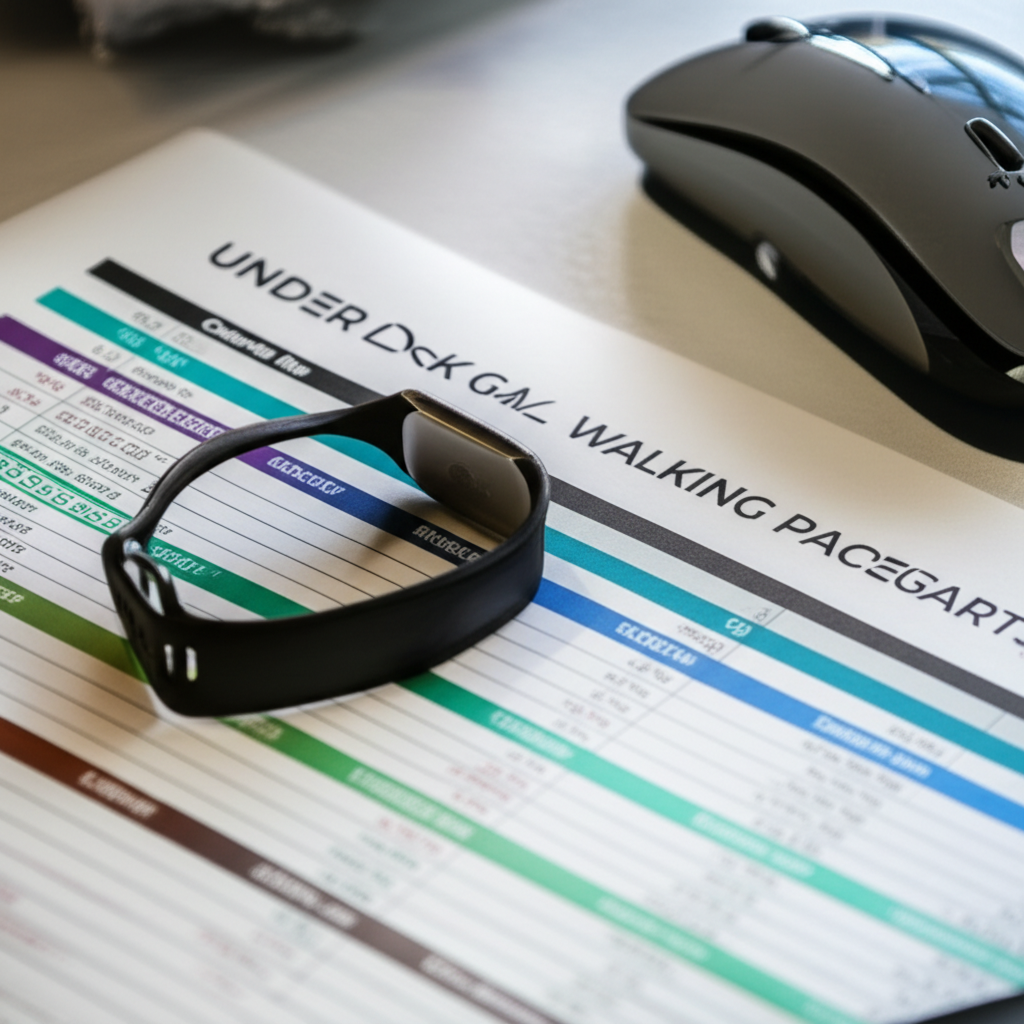
Under desk walking calories chart (1.0–3.0 mph)
Here’s the simple chart most people are looking for. These are estimates per hour at common under-desk speeds for different body weights. Therefore, you can scale it instantly: 30 minutes is about half, 20 minutes is about one-third, and so on.
| Pace | Approx MET | 130 lb (59 kg) | 160 lb (73 kg) | 190 lb (86 kg) | 220 lb (100 kg) |
|---|---|---|---|---|---|
| 1.0 mph (very easy) | ~2.0 | ~74 cal/hr | ~92 cal/hr | ~108 cal/hr | ~126 cal/hr |
| 1.5 mph (easy) | ~2.3 | ~85 cal/hr | ~106 cal/hr | ~125 cal/hr | ~146 cal/hr |
| 2.0 mph (brisk for desk work) | ~2.8 | ~104 cal/hr | ~129 cal/hr | ~152 cal/hr | ~177 cal/hr |
| 2.5 mph (fast-ish) | ~3.3 | ~122 cal/hr | ~152 cal/hr | ~179 cal/hr | ~208 cal/hr |
| 3.0 mph (very brisk) | ~3.8 | ~141 cal/hr | ~175 cal/hr | ~206 cal/hr | ~240 cal/hr |
Reality check: Your treadmill display and smartwatch may show different numbers. That’s normal. In fact, wrist trackers often undercount desk walking because your arms don’t swing much, while treadmill estimates can be optimistic. Because of this, I’d pick one method and watch the trend week to week rather than chasing “perfect” precision.
How many steps (or minutes) should you aim for each day?
This is where people overcomplicate things. Instead, I keep it simple: start with a target you can hit on a messy workday, not your best day. For many beginners, that’s 30–60 minutes total spread out.
- Beginner target: 30 minutes/day at 1.5–2.0 mph (split into 2–3 chunks)
- Intermediate target: 60–90 minutes/day at 1.8–2.5 mph
- Higher target: 90–150 minutes/day at 2.0–3.0 mph (only if joints feel great)
If you prefer steps, a decent desk-walking estimate is ~2,000 steps per mile for many adults (it varies, but it’s close enough for planning). Therefore:
- 1 mile ≈ 2,000 steps (about 30 minutes at 2.0 mph)
- 2 miles ≈ 4,000 steps (about 60 minutes at 2.0 mph)
Notably, step counts can help motivation. However, minutes are often easier during the workday. Personally, I’ll set a time goal (like 2 x 25-minute blocks), then treat the steps as a fun “score.”
Can under-desk walking actually help with weight loss?
Yes—if it increases your total weekly movement without making you ravenous or injured. That’s the whole point. Under-desk walking is basically a sneaky way to boost NEAT (non-exercise activity thermogenesis), which can make a real dent over time.
To anchor this with a couple stats:
- According to CDC guidance, adults should aim for 150 minutes/week of moderate-intensity activity (plus muscle strengthening). Even if this feels “light,” it can still help you rack up more minutes moving. Source: CDC – How much physical activity do adults need?
- Research from NIH reports that adults who took 8,000 steps/day had a 51% lower risk of all-cause mortality vs. 4,000 steps/day (and 12,000 steps/day was linked to a 65% lower risk). Source: NIH – Steps per day and health
- According to a 2024 survey by the American Psychological Association, 77% of workers reported work-related stress in the past month—so building movement into desk time can be a practical stress-buffering habit. Source: APA – Work in America
Meanwhile, don’t ignore food. A lot of people burn 100–200 extra calories and then “accidentally” eat 400 more at night because they feel they earned it. Been there. If you can keep protein high and meals boring-simple on weekdays, the extra movement often does the rest.

Beginner comfort + safety tips (posture, breaks, knees, and feet)
I’m going to be blunt: discomfort is the #1 reason people quit. However, the fix is rarely “toughen up.” Usually, it’s setup, pacing, and breaks.
1) Nail the workstation setup
- Screen height: top of monitor roughly at eye level. Otherwise, you’ll crane your neck.
- Keyboard/mouse: keep elbows close to your sides. If you’re reaching, you’ll twist as you walk.
- Shorter stride: under the desk, take smaller steps. It’s safer and quieter.
2) Use “walk breaks,” not marathon sessions
Even if you love it, break it up. For example, try 25 minutes walking + 5 minutes standing or sitting. So, your feet get a reset and your form stays cleaner.
3) Protect your knees
- Keep speed in the “can talk normally” zone for the first 1–2 weeks.
- Increase time first, then speed. Faster isn’t always better.
- If your knees ache, shorten stride and lower pace for a few days.
4) Save your feet (seriously)
Your feet do a ton of work on a small belt. Therefore, this is where small upgrades pay off:
- Wear real walking shoes, not flat slippers.
- Rotate shoes if you can (it changes pressure points).
- Consider a thin insole if you get hot spots.
5) Don’t multitask too hard at first
Typing is fine. However, precision tasks can be annoying until you adapt. For the first week, I did emails and meetings while walking, then saved “deep work” for seated time. That kept me from hating the treadmill.
Practical examples: what a day can look like
If you’re staring at the chart and thinking, “Cool… but how do I actually use this?”—here are two realistic day templates. I’ve used both.
- Busy day (minimum effective dose): 3 x 15 minutes at 1.5–2.0 mph (one after each meal). This feels easy, and it helps digestion too.
- Workday stack (my favorite): 2 x 30 minutes at ~2.0 mph (morning + afternoon). Add 10 minutes after dinner if you’re close to your weekly goal.
On top of that, if your goal is fat loss, pick a weekly target. For example: 5 hours/week at an easy pace. That’s 1 hour/day on weekdays. It’s boring, and that’s why it works.
Want a quick visual walkthrough of pacing and form?
I like having a short video reminder for cadence and posture, especially if you’re new and not sure what “easy” should look like. Also, watching someone else walk can make it obvious when you’re overstriding.
Summary: make it easy, make it consistent
Under desk walking calories aren’t magic, but they’re incredibly dependable. First, pick a pace you can maintain while working (often 1.5–2.0 mph). Next, stack short blocks across the day and increase time before speed. Most importantly, keep your setup comfortable—because comfort is what’ll make you come back tomorrow.
[content-egg-block template=offers_list]