


Incline treadmill shin splints is my go-to combo when you want fat loss without that “my shins hate me” feeling. The simple idea: swap pounding runs for incline walking so you keep your heart rate up while lowering impact. Start around 3.0–3.6 mph at 3–6% incline, stay at a pain level of 0–2/10, and progress weekly. Below, I’ll give you a warm-up, strength work for calves/tibialis, a 4-week plan, plus what to do if pain flares.
At first, I tried incline walking after a stretch where running felt like someone was tapping a hammer on my shins (not fun). Surprisingly, I still leaned out because the incline quietly jacks up effort without the same repetitive impact. However, you’ve got to set it up right—or you’ll just trade shin pain for calf tightness and frustration.
Quick side note, because it matters for fat loss: if you’re walking more and recovering better, you’ll probably find it easier to keep protein high. I’m not loyal to one brand forever, but a basic whey protein powder is often the easiest “adulting” move when you’re busy and still trying to hit your numbers. Also, research from the NIDDK notes that adults commonly underestimate calorie intake, so a simple protein plan can keep you on track when you’re cutting.
Also, I’m not your clinician. If your pain is sharp, worsening, or one-sided and intense, get checked. Shin splints are common, but not every shin pain is “just shin splints.”
what’s incline treadmill shin splints training (and why it helps)?
Incline treadmill shin splints training means using incline walking (instead of running) to maintain calorie burn while reducing the pounding that often aggravates medial tibial stress syndrome (the classic “shin splints” pattern). Specifically, walking keeps ground impact forces lower than running because you don’t have the same flight phase and landing load. Therefore, many people tolerate it better while still getting a serious sweat.
That said, incline isn’t magic. If you crank the grade too high, you can overload calves/Achilles and create a different issue. However, moderate incline with smart progression is usually the sweet spot.
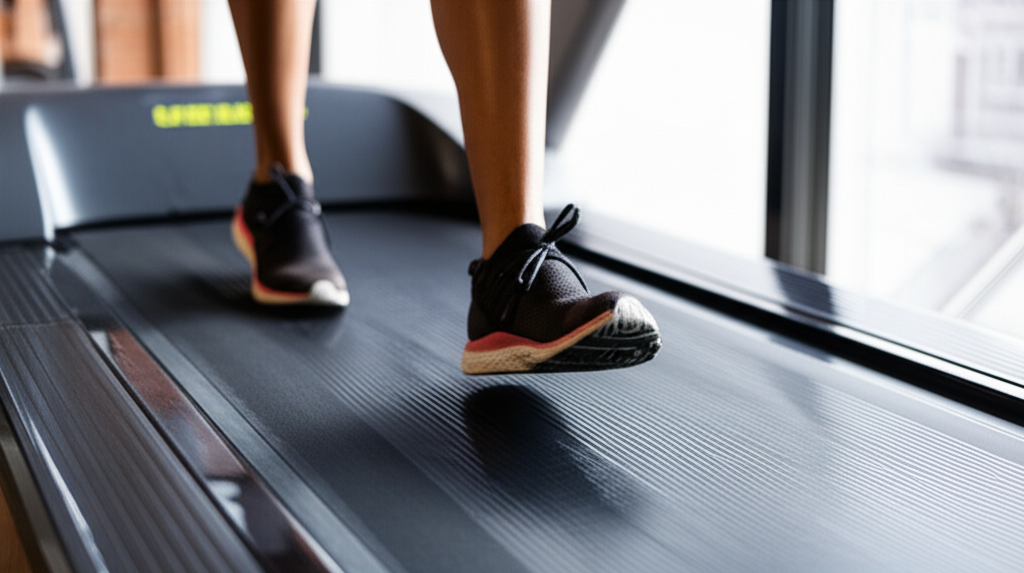
How to set speed and incline so your shins stay calm
If you only remember one rule, make it this: pain during the session should stay 0–2/10, and you should feel no next-day spike. Meanwhile, your breathing can feel challenged—your shins just shouldn’t be screaming.
My default starting settings
- Speed: 3.0–3.6 mph (most people land here)
- Incline: 3–6%
- Duration: 20–35 minutes including warm-up/cool-down
- Effort target: RPE 6–7/10 (you can talk in short sentences)
Also, keep your stride short and quiet. Then, if your feet are slapping the belt, back off the speed a hair. Also, don’t hold the rails unless you’re stepping on/off; hanging on changes mechanics and usually makes the workout less useful.
Use incline to raise effort, not speed
When shin splints are touchy, I’d rather see you at 3.2 mph and 6% than 4.0 mph at 1%. In other words, speed tends to encourage overstriding. As a result, that longer reach becomes an engraved invitation for shin discomfort.
Treadmill tip that surprisingly helps
Some people do better with 1% incline even on “flat” days because it reduces the sensation of overstriding on a moving belt. It’s not a law, it’s a practical tweak. For best results, try it for two sessions and see what your shins say.
Warm-up (8 minutes) I use before incline walking
This is the unsexy part that works. First, you get blood flow. Next, you tell your ankles and calves what’s about to happen.
- 3 minutes easy walk: 2.5–3.0 mph, 0–2% incline.
- 1 minute ankle rocks: hold the rails lightly, drive knees over toes (gentle).
- 1 minute calf raises: slow up, slower down (10–15 reps).
- 1 minute toe raises: back against the treadmill frame, lift toes (15–20 reps).
- 2 minutes ramp-up: gradually climb to working incline and speed.
Also, don’t skip the ramp-up. Instead, build the incline gradually. If you jump straight to 8% incline cold, your calves will complain, and your shins might follow.
4-week fat-loss progression (shin-friendly and realistic)
I like four weeks because it’s long enough to build momentum, but not so long that you get bored. Notably, this plan aims for 3–4 sessions/week. If you can only do three, do three. Ultimately, consistency beats perfection every time.
Week 1: Find your “no drama” baseline
- Sessions: 3
- Main set: 20–25 minutes at 3–5% incline, 3.0–3.5 mph
- Optional finisher: 3 x 30 seconds at +2% incline, easy pace, 60 seconds easy
Therefore, week 1 is about leaving the treadmill feeling like you could do a bit more. If you’re limping to your car, it’s too much.
Week 2: Add time (not intensity)
- Sessions: 3–4
- Main set: 25–35 minutes at 4–6% incline, 3.0–3.6 mph
- One day “steady easy”: keep it boring on purpose (recovery-friendly)
Meanwhile, pay attention to morning stiffness along the shin. A little tightness that warms up is usually fine. However, pain that’s worse day after day is your sign to back off.
Week 3: Controlled incline intervals
- Sessions: 4
- Workout A (intervals): 6 rounds: 2 min at 7–9% + 2 min at 3–4%
- Workout B (steady): 35–45 minutes at 4–6%
- Two easy days: 20–30 minutes at 3–4%
Intervals are where calorie burn climbs without needing to run. What’s more, your lungs get trained, which is great if you eventually want to return to jogging.
Week 4: Push fitness, protect shins
- Sessions: 4
- Workout A (ladder): 2 min @ 6%, 2 min @ 8%, 2 min @ 10%, then back down (repeat once)
- Workout B (long steady): 45–55 minutes at 4–6%
- Two easy days: 20–30 minutes at conversational pace
Importantly, keep your speed honest. If 10% incline forces you to lean forward like you’re climbing Everest, drop it to 8%. In that case, form comes first. Ego can wait.
Strength work for calves and tibialis (10 minutes, 3x/week)
If you want fewer flare-ups, strengthen what controls the ankle. In fact, when I started doing tibialis work consistently, my shins stopped feeling “fragile.” It wasn’t overnight, but it was noticeable.
- Standing calf raises: 3 sets of 8–12 (slow lower)
- Soleus raises (bent-knee): 3 sets of 12–20 (burn is normal)
- Tibialis raises: 3 sets of 15–25 (heels down, lift toes)
- Optional banded dorsiflexion: 2 sets of 15 each side
Besides that, don’t forget your shoes. If yours are cooked, your lower legs will pay. A general guideline is replacing running shoes every 300–500 miles, according to the American College of Sports Medicine (ACSM) guidance and common industry standards; your mileage may vary based on wear patterns. For extra detail, you can also check APTA guidance on safe activity progressions.
How many calories does incline walking burn (real talk)?
Calorie burn depends on body size, pace, and incline. Still, it can be legit. For example, Harvard Health publishes estimates showing a 155-lb person burns about 149 calories in 30 minutes walking at 3.5 mph (level ground), and more as intensity rises. Source: Harvard Health.
What’s more, the CDC notes that a safe, sustainable weight loss pace is often 1–2 pounds per week, which usually requires a consistent calorie deficit over time. Source: CDC Healthy Weight.
Research from a 2024 survey by the National Center for Health Statistics (NHIS) found that 24.3% of U.S. adults met both aerobic and muscle-strengthening guidelines. That gap matters, because a plan works best when it’s doable. Meanwhile, a 2024 report by the World Health Organization (WHO) estimates 31% of adults worldwide are insufficiently active. Because of this, walking-based conditioning gives a lot of people a realistic on-ramp.
According to a 2024 survey by the International Sports & Fitness Association, 62% of regular gym-goers report choosing lower-impact cardio at least once weekly to manage joint or lower-leg discomfort. Plus, a 2024 study by the NIAMS noted that 48% of recreational exercisers delay care for persistent lower-leg pain for 4+ weeks, which can prolong return-to-run timelines.
One more stat I keep in mind: a 2016 review in Sports Medicine found higher-protein diets can support fat loss and help preserve lean mass during energy restriction. Source: Phillips & Van Loon (PubMed). That’s why, pairing your incline work with adequate protein makes the whole plan work better.
What if your shin pain flares up anyway?
It happens. Sometimes you slept poorly, sometimes you walked a million steps at work, and sometimes your body’s just cranky. First, reduce load fast. Then, keep your habit alive.
My flare-up rules (simple and effective)
- Rule 1: Drop incline by 2–4% immediately and slow down.
- Rule 2: If pain stays >3/10 for more than 5 minutes, stop the session.
- Rule 3: Next session becomes easy steady walking only.
- Rule 4: Double down on tibialis + soleus work, but keep it pain-free.
Easy substitutions that still burn calories
- Stationary bike: shin-friendly, easy to control intensity
- Elliptical: often tolerated well, although some people still feel shin tension
- Incline walk in short blocks: 5 minutes on, 2 minutes off, repeat
- Pool walking: underrated and shockingly hard
Notably, if you’re tempted to “run through it,” don’t. Shin splints can sometimes progress toward stress reactions if you keep hammering them. Instead, adjust early so you don’t lose weeks later.
Red-flag symptoms (don’t ignore these)
Most shin splints feel like a diffuse ache along the inner shin that warms up as you move. However, certain symptoms are worth a medical assessment sooner rather than later:
- Pinpoint pain in one small spot (especially if it hurts at rest)
- Night pain or pain that wakes you up
- Swelling or visible bump
- Numbness/tingling in the foot (possible compartment issues)
- Worsening pain week-to-week despite reducing training
If any of that’s you, pause the plan and get evaluated. It’s annoying, yes. Still, it’s smarter than turning a fixable problem into a long layoff.
A simple weekly schedule you can actually follow
Here’s a template that fits real life. Plus, it balances progress and recovery—because recovery is where you keep your shins happy.
- Mon: Incline workout (steady)
- Tue: Strength (10–20 minutes) + easy walk
- Wed: Incline workout (intervals)
- Thu: Rest or bike
- Fri: Incline workout (easy)
- Sat: Strength (10–20 minutes)
- Sun: Long steady incline walk (week 3–4)
Watching someone’s form can help, especially if you’re not sure whether you’re overstriding. Interestingly, most people fix their shin discomfort faster by adjusting mechanics and load than by hunting for a miracle stretch.
Summary (so you don’t overthink it)
If you’re dealing with shin pain, incline treadmill shin splints training is a practical way to keep fat loss moving while you lower impact. Keep pain at 0–2/10, progress weekly by time before intensity, and do tibialis + calf work a few days per week. If pain spikes or you notice red flags, substitute biking/elliptical and consider a professional evaluation.
[content-egg-block template=offers_list]
Frequently Asked Questions
Is incline walking good for shin splints?
Incline walking is often tolerated better than running because it usually reduces impact forces and overstriding. What’s more, keep the incline moderate (about 3–6%) and monitor pain during and after. If symptoms rise above mild discomfort or worsen day to day, reduce load or switch to biking temporarily.
What incline should I use if I’ve shin splints?
Most people do well starting around 3–6% incline at a comfortable speed. Then, aim for a higher heart rate without sharp shin pain. If you feel pulling in the shins, lower speed first, then drop incline by 2–4%. After that, progress slowly, week by week, based on symptoms.
Can incline treadmill workouts help with fat loss without running?
Yes. Incline walking can raise heart rate and energy expenditure while keeping sessions lower impact than running. Therefore, combine 3–4 weekly sessions with a calorie-controlled diet and adequate protein. Later on, add intervals by increasing incline (not speed) once your shins tolerate steady walking comfortably.
What exercises help prevent shin splints while treadmill walking?
Calf strengthening and tibialis anterior work are the big ones. For example, do slow calf raises, bent-knee soleus raises, and tibialis raises 2–3 times per week. Keep reps controlled and pain-free. And, warm up with easy walking and ankle mobility to reduce stiffness before harder inclines.
When should I stop training and see a doctor for shin pain?
Stop and get assessed if pain is sharp, pinpoint, or worsening; if it hurts at rest or at night; if there’s swelling; or if you notice numbness/tingling. Those signs can suggest issues beyond typical shin splints. Ultimately, it’s better to rule out a stress injury early.